Activity 12: What is AWS

Introduction: Start with a brief overview of AWS and its role in the cloud computing landscape.
Amazon Web Services offers a broad set of global cloud-based products including compute, storage, databases, analytics, networking, mobile, developer tools, management tools, IoT, security, and enterprise applications: on-demand, available in seconds, with pay-as-you-go pricing. From data warehousing to deployment tools, directories to content delivery, over 200 AWS services are available.
New services can be provisioned quickly, without the upfront fixed expense. This allows enterprises, start-ups, small and medium-sized businesses, and customers in the public sector to access the building blocks they need to respond quickly to changing business requirements. This whitepaper provides you with an overview of the benefits of the AWS Cloud and introduces you to the services that make up the platform.
Key Features: Highlight AWS services like EC2, S3, RDS, and Lambda.
Amazon Elastic Compute Cloud (EC2)
- EC2 is the cornerstone of AWS's IaaS offering, providing virtual machines (instances) that act as your virtual servers. You can choose from a variety of instance types, each optimized for different workloads, such as general-purpose, compute-optimized, memory-optimized, and GPU instances.
Key Features of EC2
Scalability: EC2 instances can be easily scaled up or down to meet changing workload demands, offering flexibility for businesses with varying computing needs.
Instance Types: AWS offers a diverse range of instance types to cater to specific use cases, providing optimized performance for different applications.
Security: EC2 instances can be secured using AWS Identity and Access Management (IAM) roles, security groups, and network access control lists (ACLs) to control traffic and access.
Elastic Load Balancing: EC2 instances can be integrated with Elastic Load Balancing to distribute incoming traffic across multiple instances, ensuring high availability and fault tolerance.
Amazon Simple Storage Service (S3)
- S3 is AWS's object storage service, providing a scalable and durable platform for storing and retrieving data, such as files, images, and videos. It offers high durability, availability, and security for stored objects.
Key Features of S3
Scalability: S3 is designed to handle massive amounts of data, allowing users to store and retrieve data without worrying about capacity constraints.
Data Life Cycle Management: S3 provides tools for automatically moving data to different storage classes based on access patterns and retention policies, optimizing storage costs.
Data Versioning: S3 supports versioning, allowing users to preserve, retrieve, and restore every version of every object stored in a bucket.
Security: S3 offers robust security features, including access control policies, encryption options, and integration with AWS Identity and Access Management(IAM).
Amazon Relational Database Service (RDS)
- RDS is AWS's managed relational database service, simplifying database administration tasks such as provisioning, patching, backup, recovery, and scaling. It supports multiple database engines, including MySQL, PostgreSQL, SQL Server, and Oracle.
Key Features of RDS
Managed Service: RDS handles routine database management tasks, allowing users to focus on application development rather than database maintenance.
Automatic Backups: RDS provides automated daily backups with user-defined retention periods, ensuring data durability and recoverability.
Scalability: RDS instances can be easily scaled vertically or horizontally to meet performance and capacity requirements.
High Availability: RDS offers multi-availability zone deployments to ensure high availability and fault tolerance.
AWS Lambda
- Lambda is a serverless compute service that allows you to run code without provisioning or managing servers. It automatically scales your code to match traffic, reducing operational costs. Lambda integrates with other AWS services, such as Amazon S3 and Amazon DynamoDB, to enable various use cases like app backends, data processing, and real-time stream processing.
Key Features of Lambda
Serverless Computing: Lambda eliminates the need to provision or manage servers, allowing developers to focus on code execution.
Automatic Scaling: Lambda automatically scales your code based on traffic, ensuring efficient resource utilization.
Integration with Other AWS Services: Lambda seamlessly integrates with other AWS services, enabling a wide range of use cases.
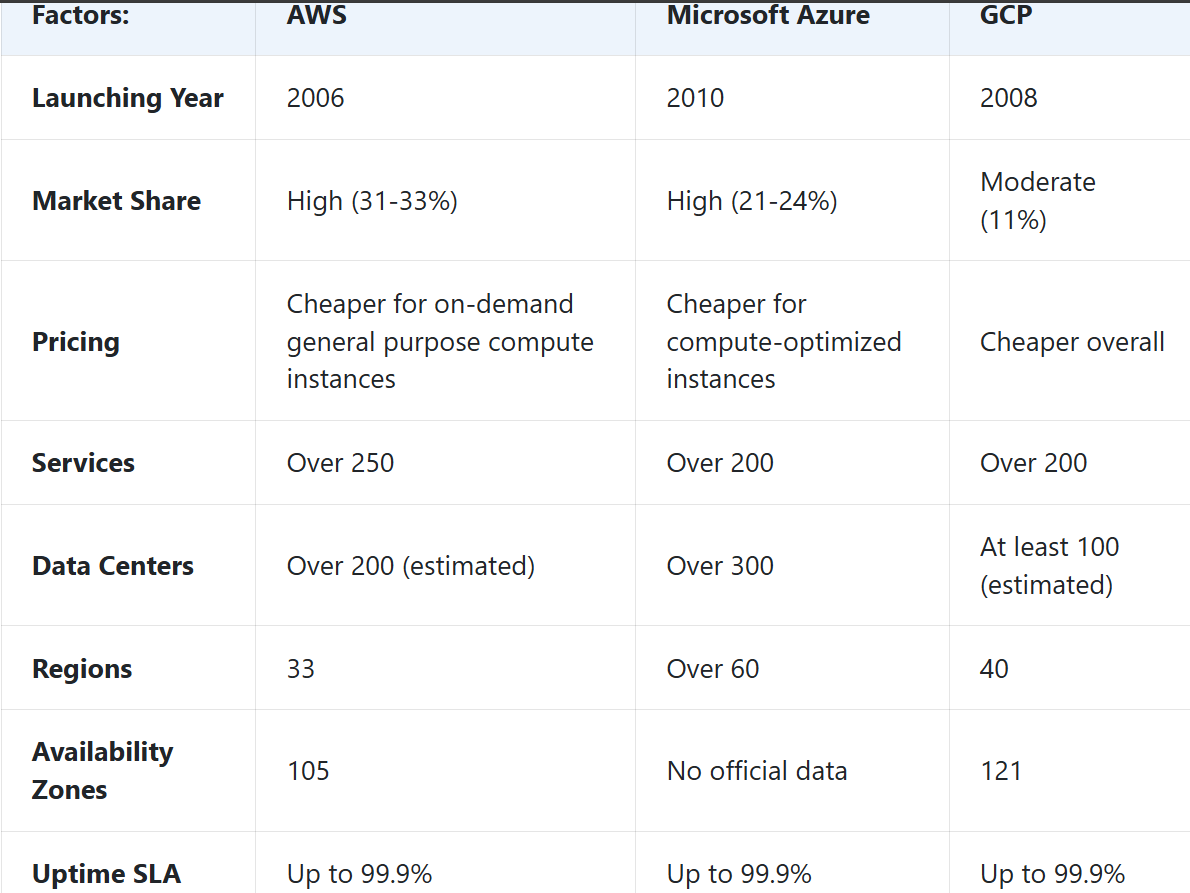
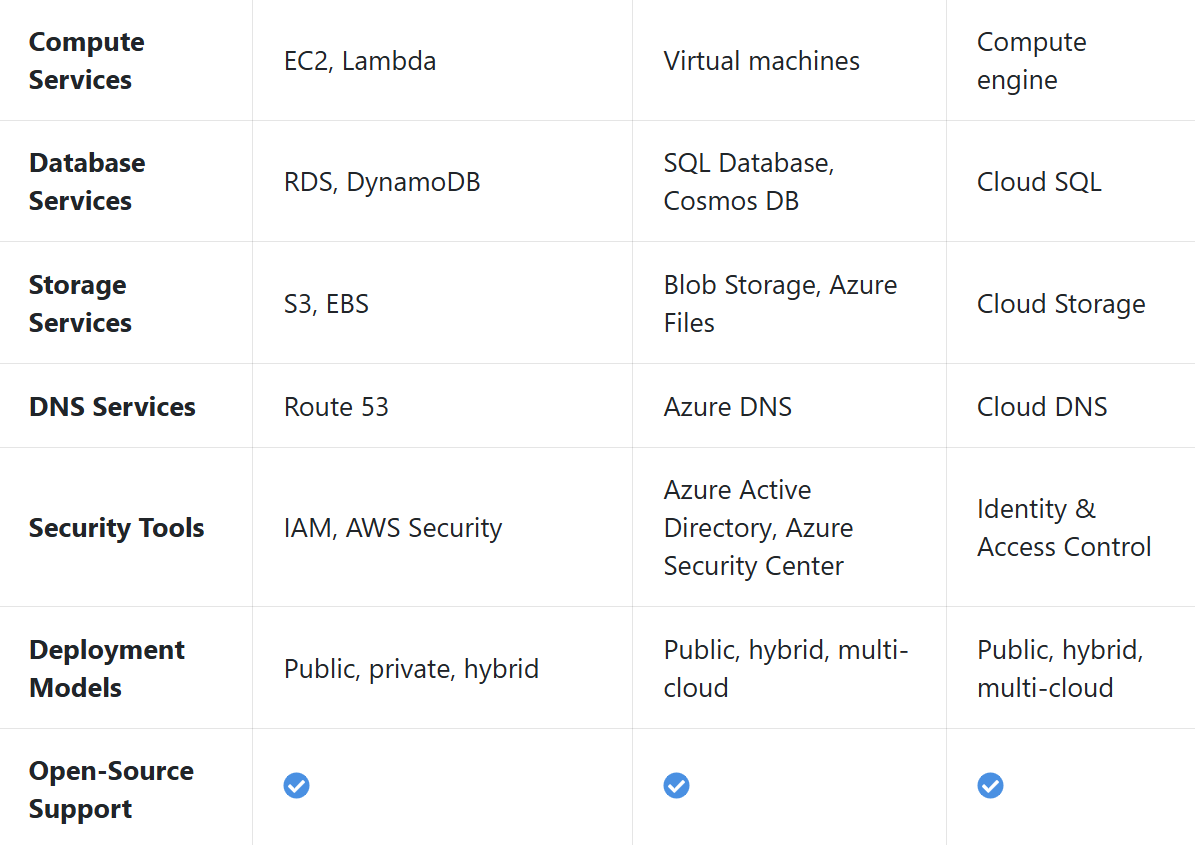
Comparison: Compare AWS to its competitors such as Azure and Google Cloud.
- The AWS vs Azure vs Google Cloud debate is often contested. Since all three cloud providers have some of the best internet-based computing services, wading through countless services and pricing tiers can be daunting. Choosing the right one often depends on your use case and budget, so knowing each platform’s strengths and weaknesses will let you make an educated decision. Amazon Web Services (AWS) is currently the largest provider in the commercial cloud computing world. However, considering that it made cloud computing mainstream, this comes as no surprise. Microsoft Azure is the closest contender to AWS in terms of market size. It is popular for its seamless integration with other Microsoft products and services. Google Cloud Platform (GCP) has the third-highest international market share. Its core strength lies in big data and machine learning.
Benefits: Discuss why AWS is a great option for both small businesses and large enterprises.
- AWS offers a compelling platform for both small businesses and large enterprises, providing the flexibility, scalability, cost-effectiveness, and security features needed to succeed in today's digital landscape. Its comprehensive service offerings, global reach, and continuous innovation make it a powerful tool for organizations of all sizes seeking to leverage the benefits of cloud computing.


